Let \(f_{n}:A\to \mathbb{R}\) be a sequence of functions. Consider \(S_{n}(x) = \sum_{i=1}^{n} f_{i}(x)\). Note that \(S_{n}(x)\) is a sequence of functions
Definition (convergence of a series of functions)
We say that \(\sum_{n=1}^\infty f_{n}(x)\) converges:
- pointwise if the \(S_{n}(x)\) converge pointwise.
- uniformly if the \(S_{n}(x)\) converge uniformly
- absolutely if \(\sum_{i=1}^{\infty} \lvert f_{i}(x) \rvert\) converges (pointwise or uniformly).
Lemma (Cauchy if and only if uniform convergence)
Let \(f_{n}:A\to \mathbb{R}\) be functions. Then \(\sum_{n=1}^\infty f_{n}\) converges uniformly if and only if for every \(\varepsilon>0\) there exists \(N\) such that for every \(x \in A\)
if \(n,m \geq N\). Equivalently, if \(n>m\geq N\), then for every \(x \in A\)
\[\lvert f_{m+1}(x) + f_{m+2}(x) + \dots + f_{n}(x) \rvert < \varepsilon.\]Lemma (Weierstrass M-test)
Let \(f_{n}:A\to \mathbb{R}\) be a sequence of functions and \(\{a_{n}\}_{n=1}^\infty\) a convergent sequence such that
- \(\sum_{n=1}^\infty a_{n}\) converges,
- \(\lvert f_{n}(x) \rvert \leq a_{n}\) for every \(x \in A\).
Then \(\sum_{n=1}^\infty \lvert f_{n}(x) \rvert\) converges uniformly.
Proof: Given \(\varepsilon>0\) there exists \(N\) such that for all \(n,m\geq N\)
\[\begin{aligned} \lvert a_{m}+a_{m+1}+\dots+a_{n} \rvert < \varepsilon \iff &a_{m} + a_{m+1} + \dots + a_{n} < \varepsilon \\ \implies \lvert f_{m}(x) \rvert + \lvert f_{m+1}(x) \rvert + \dots+ \lvert f_{n}(x) \rvert < \quad &a_{m} + a_{m+1} + \dots + a_{n} < \varepsilon \end{aligned}\]for every \(x \in A\), \(n,m\geq N\).
Example
Consider \(\sum_{k=1}^\infty \frac{\sin(kx)}{k^{2}}\). Note that \(\left\lvert \frac{\sin(kx)}{k^{2}} \right\rvert \leq \frac{1}{k^{2}}\). Since \(\sum_{k=1}^\infty \frac{1}{k^{2}}\) converges, by the M-test \(\sum_{k=1}^\infty \frac{\sin(kx)}{k^{2}}\) converges uniformly.
Example
Consider \(\sum_{k=1}^\infty x^{k}\) for \(\lvert x \rvert<1\). In those cases it converges pointwise. Let \(0<a<1\). If \(\lvert x \rvert \leq a\), then \(f_{n}(x) = \lvert x \rvert^{n} \leq a^{n} = a_{n}\). Since \(a<1\), the series \(\sum_{n=1}^\infty a^{n}\) converges. Then by the M-test, \(\sum_{n=1}^\infty x^{n}\) converges uniformly on \(\lvert x \rvert \leq a\).
Lemma (Continuity, integrability and differentiability)
Let \(f_{n}:A\to \mathbb{R}\) be a sequence of functions such that \(\sum_{n=1}^\infty f_{n}(x)\) converges uniformly to a function \(f(x)\).
- If \(f_{n}(x)\) is continuous then \(f(x)\) is continuous.
- If the \(f_{n}\) are R-integrable, then \(f\) is R-integrable. Moreover
- If \(f_{n}:A \to \mathbb{R}\) is differentiable and
- \(\sum_{n=1}^\infty f_{n}'(x)\) converges uniformly
- \(\sum_{n=1}^\infty f_{n}(x_{0})\) converges for some \(x_{0} \in A\),
then \(\sum_{n=1}^\infty f_{n}(x)\) converges uniformly to a function \(f(x)\) and \(f'(x) = \sum_{n=1}^\infty f_{n}'(x)\).
Example
Let \(f_{n}(x) = \frac{x^{n}}{n^{3}}\). Does \(\sum_{n=1}^\infty \frac{x^{n}}{n^{3}}\) converge uniformly on \([-1,1]\)? Since \(\left\lvert \frac{x^{n}}{n^{3}} \right\rvert \leq \frac{1}{n^{3}}\) and \(\sum_{n=1}^\infty \frac{1}{n^{3}}\) converges, the series converges uniformly by the M-test.
Let \(f(x) = \sum_{n=1}^\infty \frac{x^{n}}{n^{3}}\); then \(f\) is continuous and R-integrable. On the other hand, \(f_{n}'(x) = \frac{nx^{n-1}}{n^{3}} = \frac{x^{n-1}}{n^{2}}\), which converges uniformly by the M-test, since
\[\frac{x^{n-1}}{n^{2}} \leq \frac{1}{n^{2}} \quad \text{and} \quad \sum_{n=0}^\infty \frac{1}{n^{2}} \text{ converges.}\]Moreover, \(f'(x) = \sum_{n=1}^\infty \frac{x^{n-1}}{n^{2}}\).
Theorem (Dirichlet’s test)
Let \(f_{n}:A\to \mathbb{R}\) be a sequence of functions such that
- there exists \(M \in \mathbb{R}\) such that
Assume moreover that \(g_{n}:A\to \mathbb{R}\) satisfies
- \(g_{n} \geq 0\) ,
- \(g_{n}(x)\geq g_{n+1}(x)\) for every \(x \in A\) (decreasing in \(n\)) ,
- \(\lim_{ n \to \infty } g_{n}(x) = 0\) uniformly.
Then \(\sum_{n=1}^\infty f_{n}(x)g_{n}(x)\) converges uniformly.
Proof: Consider
\[\sum_{k=n}^{m} f_{k}(x) g_{k}(x) = g_{m}(x)S_{m}(x) - g_{n}(x) S_{n-1}(x) + \sum_{j=n}^{m-1} (g_{j}-g_{j+1}) S_{j} (x),\]where \(S_{m}(x) = \sum_{i=1}^{m} f_{i}(x)\). Given \(\varepsilon>0\), there exists \(N\) such that for every \(x \in A\), \(\lvert g_{n}(x) \rvert < \frac{\varepsilon}{2M}\) if \(n\geq N\). Now,
\[\begin{aligned} \left\lvert \sum_{j=n}^{m-1} (g_{j}(x) - g_{j+1}(x))S_{j}(x) \right\rvert &\leq \sum_{j=n}^{m-1} \lvert g_{j}(x) - g_{j+1}(x) \rvert \lvert S_{j}(x) \rvert \\ & \leq M \sum_{=}^\infty (g_{j}(x)-g_{j+1}(x)) \\ & = M(g_{n}(x)-g_{m}(x)). \end{aligned}\]Therefore
\[\begin{aligned} \left\lvert \sum_{k=n}^{m} f_{k}(x) g_{k}(x) \right\rvert &\leq \lvert g_{n}(x) \rvert \lvert S_{m}(x) \rvert + \lvert g_{n}(x) \rvert \lvert S_{n-1}(x)\rvert + M (g_{n}(x)-g_{m}(x)) \\ &\leq g_{m}(x) M + g_{n}(x) M + M(g_{n}(x) - g_{m}(x)) = 2M g_{n}(x) < \varepsilon. \end{aligned}\]Example
Consider \(\sum_{k=1}^{\infty} \frac{\sin(kx)}{k}\). Note that
\[\left\lvert \sum_{k=1}^{n} \sin(kx) \right\rvert =\frac{\left\lvert \cos\left( \frac{x}{2} \right) - \cos\left( \left( n-\frac{1}{2} \right) x\right) \right\rvert}{2 \sin\left( \frac{x}{2} \right)} \leq \frac{2}{2\sin(x^{2})} < M\]for every \(x \in [\delta, 2\pi-\delta\), with \(0 < \delta <n - \delta\).
Theorem (Abel’s test)
Let \(f_{n}:A\to \mathbb{R}\) be a sequence of functions such that
- \(\sum_{n=1}^{\infty} f_{n}(x)\) converges uniformly.
- \(g_{n}:A\to \mathbb{R}\) is monotone,
- there exists \(K \in \mathbb{R}\) such that \(\underset{x \in A}{\sup}\{ \lvert g_{n}(x) \rvert \} \leq k\) for every \(n \in \mathbb{N}\). Then \(\sum_{n=1}^{\infty} f_{n}(x) g_{n}(x)\) converges uniformly.
Proof: Let \(S = \sum_{n=1}^\infty f_{n}(x)\) and \(S_{n}(x) = \sum_{k=1}^{n} f_{k}(x)\). Note that
\[\begin{aligned} \sum_{j=n}^{m} f_{j}(x)g_{j}(x) &= g_{m} S_{m} - g_{n} S_{n-1} + \sum_{j=n}^{m-1} (g_{j}-g_{j-1}) S_{j} \\ &= g_{m}(S-S_{m}) - g_{n}(S-S_{n-1}) + \sum_{j=n}^{m-1} (g_{j}-g_{j+1})(S-S_{j}) \end{aligned}\]Given \(\varepsilon>0\), there exists \(N \in \mathbb{N}\) such that for every \(\ell\geq N\) and every \(x \in A\),
\[\lvert S(x)-S_{\ell}(x) \rvert < \frac{\varepsilon}{3K}\]for \(\ell\geq N\) and \(x \in A\). Then
\[\begin{aligned} \lvert g_{n}(x) \rvert \lvert S(x) - S_{n-1}(x) \rvert &< \frac{\varepsilon}{4} \\ \lvert g_{n}(x) \rvert \lvert S(x) - S_{m}(x) \rvert &< \frac{\varepsilon}{4}, \end{aligned}\]if \(n-1,m\geq N\). On the other hand,
\[\begin{aligned} \left\lvert \sum_{j=n}^{m-1} (g_{j}(x) - g_{j+1}(x))(S(x)-S_{j}(x)) \right\rvert &\leq \sum_{j=n}^{m-1} \lvert g_{i}(x) - g_{i+1}(x) \rvert \lvert S(x) - S_{j}(x) \rvert \\ &< \frac{\varepsilon}{4k} \sum_{j=n}^{m-1} \lvert g_{j}(x) - g_{j-1}(x) \rvert \end{aligned}\]Example
Consider \(S(x) = \sum_{n=1}^\infty \frac{(-1)^{n}}{n}e^{-xn}\) for \(x \in [1,+\infty)\). Note that \(\lvert g_{n}(x) \rvert = \left\lvert \frac{1}{n} \right\rvert \leq 1\). Now, \(\lvert (-1)^{n} \exp(-xn) \rvert \leq \exp(-n)\) and \(\sum_{n=1}^\infty \exp(-n)\) converges, so the series under study converges uniformly.
Power series
Consider \(f_{n}(x) = a_{n} x^{n}\) and \(S_{n}(x) = \sum_{k=0}^{n} a_{n} x^{n}\), where \(\{a_{n}\}_{n=0}^\infty\) is a sequence.
Consider \(\sqrt[n]{\lvert a_{n} \rvert \lvert x^{n} \rvert} = \lvert x \rvert \sqrt[n]{\lvert a_{n} \rvert}\). To apply the root test I need to study \(\sqrt[n]{\lvert a_{n} \rvert}\). We are going to prove that there is uniform convergence on \([-p,p]\), with \(p < R\), and pointwise convergence on \((-R,R)\).
\[p + \varepsilon < R =\frac{1}{\limsup \sqrt[n]{\lvert a_{n} \rvert}} \iff \limsup \sqrt[n]{\lvert a_{n} \rvert } < \frac{1}{p+\varepsilon}.\]If \(\limsup \sqrt[n]{\lvert a_{n} \rvert} = \underset{n\geq 1}{\inf} \underset{k\geq n}{\sup} \{ \sqrt[k]{\lvert a_{k} \rvert } \} < \frac{1}{p+\varepsilon}\), then there exists \(n_{0}\) such that
\[\underset{k\geq n_{0}}{\sup} \{ \sqrt[k]{\lvert a_{k} \rvert } \} < \frac{1}{p+\varepsilon}.\]Then \(\sqrt[k]{\lvert a_{k} \rvert} \leq \frac{1}{p + \varepsilon}\) for every \(k\geq n_{0}\). Now,
\[\begin{aligned} \sqrt[n]{\lvert a_{k} \rvert } < \frac{1}{p+\varepsilon} &\iff \lvert a_{k} \rvert < \frac{1}{(p+\varepsilon)^{k}} \\ &\implies \lvert x^{k} \rvert \lvert a_{k} \rvert < \left( \frac{\lvert x \rvert }{p+\varepsilon} \right)^k \leq \left( \frac{p }{p+\varepsilon} \right)^k \end{aligned}\]for \(\lvert x \rvert \leq p\). Since \(\sum_{k=1}^\infty \left( \frac{p}{p+\varepsilon} \right)^{k}\) converges, we conclude that \(\sum_{k=1}^\infty a_{k} x^{k}\) converges uniformly by the M-test.
So the series converges pointwise on \((-R, R)\) with \(R = \frac{1}{\limsup \sqrt[n]{ \lvert a_{n} \rvert}}\) and converges uniformly on \([-p,p]\) with \(p < R\). The same applies to \(\hat{S}(x) = \sum_{k=1}^\infty a_{k}(x-x_{0})^{k}\), which converges pointwise if \(-R < x-x_{0} < R\).
Exercise
Let \(\{a_{n}\}_{n=1}^\infty\) and \(\{b_{n}\}_{n=1}^\infty\) be two sequences with \(b_{n} \underset{n \rightarrow \infty}{\longrightarrow}b\). Then
- \(\limsup(a_{n}+b_{n}) = (\limsup a_{n}) + b\).
- \(\limsup(a_{n} b_{n}) = b \limsup a_{n}\).
Lemma (Differentiation and radius of convergence)
Let \(f_{n}(x) = a_{n} x^{n}\) and \(f_{n}'(x) = n a_{n} x^{n}\). Then the power series \(S(x) = \sum_{n=0}^\infty f_{n}(x)\) and \(S'(x) = \sum_{n=0}^\infty n a_{n} x^{n-1}\) have the same radius of convergence.
Proof: Consider \(\sum_{n=0}^\infty a_{n} n x^{n-1}\), which has radius of convergence \(\frac{1}{\limsup \sqrt[n]{n \lvert a_{n} \rvert}}\). Expanding:
\[\limsup \sqrt[n]{n \lvert a_{n} \rvert } = \limsup \sqrt[n]{n} \sqrt[n]{\lvert a_{n} \rvert } = \limsup \sqrt[n]{a_{n}},\]where we used the fact that
\[\lim_{ n \to \infty } \sqrt[n]{n} = \lim_{ n \to \infty } \exp\left( \frac{\ln(n)}{n} \right) = \exp(0) = 1.\]Hence the series
\[\sum_{n=0}^\infty n a_{n} x^{n-1} = \frac{1}{x}\sum_{n=0}^\infty n a_{n} x^{n} \quad \text{and} \quad \sum_{n=0}^\infty a_{n}x^{n}\]have the same radius of convergence.
Lemma (R-integration and radius of convergence)
Proof: If \(S(x) = \sum_{n=0}^\infty a_{n} x^{n}\) converges uniformly on \([-p,p]\) with \(p <R\), then
\[\int_{0}^{x} S(y) \, dy = \sum_{n=0}^\infty \int_{0}^{x} a_{n} y^{n} \, dy = \sum_{n=0}^\infty a_{n} \frac{x^{n+1}}{n+1}.\]Analysing the radius of convergence, note that
\[\limsup \sqrt[n]{\frac{\lvert a_{n} \rvert }{n+1}} = \limsup \frac{\sqrt[n]{\lvert a_{n} \rvert }}{\sqrt[n]{n+1}} = \limsup \sqrt[n]{\lvert a_{n} \rvert, }\]since \(\limsup \sqrt[n]{n+1} = \lim_{ n \to \infty } \sqrt[n]{n+1}\). We conclude then that
\[\sum_{n=0}^\infty a_{n} \frac{x^{n+1}}{n+1} \quad \text{and} \quad \sum_{n=0}^\infty a_{n}x^{n}\]have the same radius of convergence.
Taylor series
Example
Let \(\lvert x \rvert < 1\) and consider \(\sum_{n=0}^\infty x^{n} = \frac{1}{1-x}\). Since \(\limsup \sqrt[n]{1} = 1\), we have uniform convergence on \([-p,p]\), with \(0<p<1\). Then
\[\begin{aligned} \int_{0}^{x} \frac{1}{1-y} \, dy &= \int_{0}^{x} \sum_{n=0}^\infty y^{n} \, dy \\ \iff -\ln(1-x) &= \sum_{n=0}^\infty \frac{x^{n+1}}{n+1}. \end{aligned}\]Manipulating the resulting expression, for \(\lvert x \rvert < 1\) we have that
\[\begin{aligned} -\ln(1+x) &= \sum_{n=0}^{\infty} \frac{(-x)^{n+1}}{n+1} \\ \iff \ln(1+x) &= \sum_{n=0}^\infty (-1)^{n} \frac{x^{n+1}}{n+1}. \end{aligned}\]Could it happen that, for two different sequences, the associated power series converge to the same function? Note that
\[S^{(n)}(x) = \left( \sum_{k=0}^\infty a_{k} x^{k} \right)^{(n)} = \sum_{k=n}^\infty a_{k} k(k-1) \dots (k-n+1) x^{k-n}.\]Evaluating,
\[S^{(n)}(0) = n(n-1)(n-2)\dots \cdot 2 \cdot 1 \cdot a_{n} = n! a_{n} \iff \frac{S^{(n)}(0)}{n!} = a_{n},\]so the sequence \(a_{n}\) is unique for each function.
Theorem (Taylor)
Let \(f:[a,b] \to \mathbb{R}\) be a function such that \(f',f'',\dots,f^{(n)}\) are continuous on \([a,b]\). If \(f^{(n+1)}\) exists on \([a,b]\) and \(x_{0} \in (a,b)\), then there exists \(c\) between \(x_{0}\) and \(x\) such that
\[f(x) = f(x_{0}) + f'(x_{0})(x-x_{0}) + \dots+f^{(n)}(x_{0}) \frac{(x-x_{0})^{n}}{n!} + R_{n}(x),\]with \(R_{n}(x) = \frac{f^{(n+1)}(c)}{(n+1)!}(x-x_{0})^{n+1}\).
Consider the power series
\[S(x) = \sum_{n=0}^\infty a_{n}(x-x_{0})^{n}, \quad \text{with }a_{n} = \frac{f^{(n)}(x_{0})}{n!}\]Is it true that \(S(x) = f(x)\)? Consider the partial sum \(S_{k}(x) = \sum_{n=0}^{k} a_{n}(x-x_{0})^{n}\). Then
\[\lvert f(x) - S_{k}(x) \rvert = \lvert R_{k}(x) \rvert = \left\lvert \frac{f^{(n+1)}(c)}{n+1} (x-x_{0})^{n+1} \right\rvert \overset{?}{\underset{n \rightarrow \infty}{ \longrightarrow}} 0.\]If the remainder converges to zero, the Taylor series converges to the function.
Example
Consider \(f(x) = \sin(x)\). Then
\[\begin{aligned} f'(x) &= \cos(x) \\ f''(x) &= -\sin(x) \\ f'''(x) &= -\cos(x) \\ f^{(4)}(x) &= \sin(x). \end{aligned}\]In general, for \(x_{0}=0\) we have that
\[f^{(2n)}(x) = 0, \quad f^{(2n+1)}(0) = (-1)^{n}.\]Considering the Taylor series \(\sum_{n=0}^\infty (-1)^{n} \frac{x^{2n+1}}{(2n+1)!}\), note that \(\limsup \sqrt[2n+1]{\frac{1}{(2n+1)!}} = 0\). Hence the series converges on \(\mathbb{R}\) and uniformly on \([-p,p]\) for any \(p>0\). On the other hand,
\[\begin{aligned} \lvert \sin(x) - S_{n}(x) \rvert &= \left\lvert \frac{f^{(n+1)}(c)}{(n+1)!} x^{n+1} \right\rvert. \end{aligned}\]Since
\[f^{(n+1)}(c) \begin{cases} = \lvert \sin(c) \rvert \\ \\ = \lvert \cos(cazx \quad) \rvert \end{cases} \leq 1,\]we get \(\lvert \sin(x) - S_{n}(x) \rvert \leq \frac{\lvert x^{n+1} \rvert}{(n+1)!}\). Now, for \(\lvert x \rvert < p\),
\[\lvert \sin(x) - S_{n}(x) \rvert \leq \frac{\lvert \rho^{n+1} \rvert }{(n+1)!} < \varepsilon\]for \(n\geq N_{0}\), by the ratio test for limits.
Example
Consider \(f(x) = \exp(x)\). Then \(f^{(n)}(x) = \exp(x)\). Hence, for \(x_{0}=0\), the Taylor series is given by
\[\sum_{n=0}^\infty \frac{x^{n}}{n!}, \quad \text{with } R = +\infty.\]Note that
\[S'(x) = \sum_{n=1}^\infty n \frac{x^{n-1}}{n!} = \sum_{n=1}^\infty \frac{x^{n-1}}{(n-1)!} = \sum_{n=0}^\infty \frac{x^{n}}{n!}.\]We will prove that \(S(x)S(y) = S(x+y)\). Let \(c \in \mathbb{R}\) and \(h(x) = S(x)S(c-x)\). Then
\[h'(x) = S'(x)S(c-x) - S(x)S'(c-x) =S(x)S(c-x) - S(x)S(c-x) = 0,\]so \(h(x)\) is constant. Hence
\[h(x) = S(x) S(c-x) = S(c) S(0) = S(c).\]Evaluating at \(c = x+y\), we get \(S(x)S(y) = S(x+y)\).
Now,
\[\begin{aligned} \lvert \exp(x) - S_{k}(x) \rvert = \left\lvert \frac{f^{(n+1)}(c)}{(n+1)!} x^{n+1} \right\rvert = \left\lvert \frac{e^{c}}{(n+1)!} x^{n+1} \right\rvert \leq \frac{e^{p}}{(n+1)!} p^{n+1} \underset{n \rightarrow \infty}{\longrightarrow} 0 \end{aligned}\]for \(x \in [-p,p]\) with \(c\) between 0 and \(x\).
Exercise
Prove that \(\exp(x) \geq 0\) for every \(x\).
Example
Consider \(f(x) = \cos(x)\). Then
\[\cos(x) = \sum_{n=0}^\infty (-1)^{n} \frac{x^{2n}}{(2n)!}, \quad \sin(x) = \sum_{n=0}^\infty (-1)^{n} \frac{x^{2n+1}}{(2n+1)!}.\]Then
\[\begin{aligned} \cos'(x) &= \sum_{n=1}^\infty (-1)^{n} (2n) \frac{x^{2n-1}}{(2n)!} \\ &= \sum_{n=1}^\infty (-1)^{n} \frac{x^{2n-1}}{(2n-1)!} \\ &= \sum_{n=0}^\infty (-1)^{n+1} \frac{x^{2n+1}}{(2n+1)!} \\ &= - \sum_{n=0}^\infty (-1)^{n} \frac{x^{2n+1}}{(2n+1)!} = -\sin(x). \end{aligned}\]In an analogous way, we can prove that \(\sin'(x) = \cos(x)\).
Note that \(\sin(0)=0\), \(\cos(0)=1\). Moreover,
\[(\sin^{2}(x)+\cos ^{2}(x))' = 2\sin x\cos x + 2 \sin x \cos x + 2 \cos x(-\sin x) = 0.\]Hence \(\sin ^{2}(x)+\cos^{2}(x) = \sin ^{2}(0)+\cos^{2}(0) = 1\).
Exercise
Prove that \(\sin(x+y)=\sin(x)\cos(y) + \cos(x)\sin(y)\) and that \(\cos(x+y) = \cos(x)\cos(y) - \sin(x)\sin(y)\).
Now note that
\[\cos(x) = \sum_{n=}^\infty (-1)^{n} \frac{x^{2n}}{(2n)!} = \left( 1-\frac{x^{2}}{2} \right) + \left( \frac{x^{4}}{4!} - \frac{x^{6}}{6!}\right) + \cdots,\]so \(\cos(x)\geq 0\) if
\[\begin{aligned} \frac{x^{2n}}{(2n)!} - \frac{x^{2n+2}}{(2n+2)!} &\geq 0 \\ \iff {x^{2n}}{(2n)!} &\geq \frac{x^{2n+2}}{(2n+2)!} \\ \iff (2n+1)(2n+2) \geq x^{2}, \end{aligned}\]which holds for \(0\leq x\leq 1\). Note that if \(\cos(x)\geq 0\) then \(\sin'(x) \geq 0\) and so \(\sin\) is increasing. Therefore, if \(\cos(x)\geq 0\) for every \(x \in [0,p]\), \(\sin\) is increasing on \([0,p]\). Moreover, since \(\sin(0) = 0\), we have that \(\sin(x) \geq 0\) for \(x \in [0,p]\). Hence \(\cos(x)\) is decreasing.
We will now prove that there exists \(c \in \mathbb{R}\) such that \(\cos(c) < 0\). We know that \(\cos(0) = 1\) and \(\sin(0) = 0\). Using the Taylor series of the cosine, we have that
\[\cos(y) \leq 1 \iff \int_{0}^{x} \cos(y) \, dy \leq \int_{0}^{x} 1 \, dy \iff \sin(x) \leq x.\]Hence
\[\int_{0}^{x} \sin(y) \, dy \leq \int_{0}^{x} y \, dy = \frac{x^{2}}{2} \iff 1-\cos(x) \leq \frac{x^{2}}{2} \iff 1-\frac{x^{2}}{2} \leq \cos(x).\]Integrating both sides of this last inequality, we have that \(\sin(x)\geq x - \frac{x^{3}}{6}\), and integrating once more, we have that
\[\cos(x) \leq 1-\frac{x^{2}}{2}+\frac{x^{4}}{4!},\]from which, evaluating at \(x = \sqrt{ 3 }\), we get a negative value on the right-hand side and therefore prove that \(\cos(\sqrt{ 3 }) \leq 0\), i.e., there are values where the cosine is negative.
By continuity, there exists some zero of the function. Let \(p\) be the first zero.
We now analyse the period of \(\sin\) and \(\cos\). Since \(\cos(p) = 0\), we have that
\[\begin{aligned} \sin(2p) = \sin(p)\cos(p) + \sin(p) \cos(p) &= 0, \\ \sin ^{2}(p) +\cos ^{2}(p) = \sin ^{2}(p) &= 1 \implies \sin(p) = \pm 1. \end{aligned}\]Note that
\[\begin{aligned} \sin(x+4p) &= \sin(x) \cos(4p) + \cos(x) \sin(4p),\\ \sin(4p) &= \sin(2p)\cos(2p) + \sin(2p)\cos(2p) = 0 \\ \cos(4p) &= \cos(2p)^{2} - \sin(2p)^{2} = 1 \quad \text{since } \cos(2p) =\pm 1, \end{aligned}\]from which we conclude that \(\sin(x+4p) = \sin(x)\).
Example
We had seen that
\[\ln(1+x) = \sum_{n=0}^\infty (1)^{n+1} \frac{x^{n+1}}{n+1}.\]Observing that
\[\frac{(\ln(1+x))^{(n)}}{n!} \biggr\rvert_{x=0} = \frac{(-1)^{n+1}}{n+1},\]we have that the Taylor series converges to the function.
Tricks
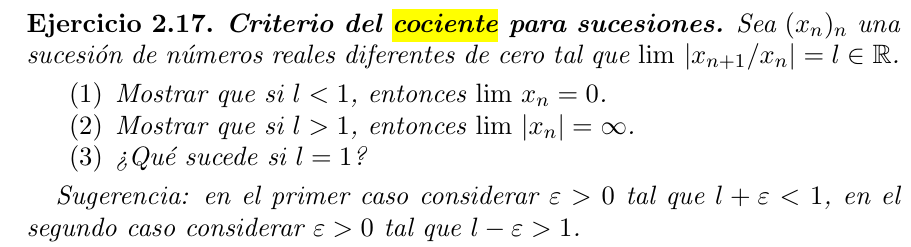
- If \(\lim_{ n \to \infty } \sqrt[n]{a_{n}}\) is very hard, use the fact that \(\lim_{ n \to \infty } \frac{a_{n+1}}{a_{n}}\) must have the same value.
- Compute the supp whenever we are stuck