The factorization theorem
Theorem (Factorization of a homomorphism through a quotient)
Let \(R, S\) be rings and \(I\) an \(R\)-ideal. Let \(f : R \to S\) be a homomorphism such that \(I \subseteq \operatorname{Ker}(f)\). Then there exists a unique homomorphism \(\bar{f} : R/I \to S\) such that
\[\bar{f}([x]) = f(x) \quad \text{for all } x \in R.\]Equivalently, \(\bar{f} \circ \pi_{I} = f\), that is, the following diagram commutes:
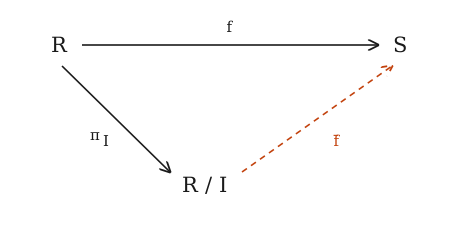
Proof: \(\bar{f}\) is well defined. If \([x] = [y]\), then
\[[x] = [y] \iff x - y \in I \subseteq \operatorname{Ker}(f) \implies f(x - y) = f(x) - f(y) = 0_{S} \implies f(x) = f(y),\]and therefore \(\bar{f}([x]) = \bar{f}([y])\).
\(\bar{f}\) is a homomorphism. As in the first isomorphism theorem, this is inherited directly from \(f\):
\[\bar{f}([x] + [y]) = \bar{f}([x + y]) = f(x + y) = f(x) + f(y) = \bar{f}([x]) + \bar{f}([y]),\]and analogously for the product; moreover \(\bar{f}([1]) = f(1) = 1_{S}\).
Uniqueness. If \(g : R/I \to S\) satisfies \(g([x]) = f(x)\) for all \(x \in R\), then \(g\) and \(\bar{f}\) agree on all the classes \([x]\), which are all the elements of \(R/I\); hence \(g = \bar{f}\).
Theorem (Bijection between homomorphisms vanishing on \(I\) and homomorphisms from the quotient)
Let \(R, S\) be rings and \(I\) an \(R\)-ideal. The map \(f \mapsto \bar{f}\) is a bijection
\[\{ f \in \operatorname{Hom}(R, S) :\ f(I) = \{0\} \} \longrightarrow \operatorname{Hom}(R/I, S).\]Proof: Exercise.
Exercise (The unique homomorphism from \(\mathbb{Z}\))
If \(f : \mathbb{Z} \to R\), with \(R\) a ring, is a homomorphism, then \(f(n) = n \cdot 1_{R}\); in particular, there is a unique homomorphism \(\mathbb{Z} \to R\).
Example (The homomorphisms from \(\mathbb{Z}_{m}\) to \(\mathbb{Z}_{n}\))
Let \(m, n \in \mathbb{Z}^{+}\). What are the elements of \(\operatorname{Hom}(\mathbb{Z}_{m}, \mathbb{Z}_{n})\)? By the bijection of the previous theorem, with \(R = \mathbb{Z}\) and \(I = (m)\),
\[|\operatorname{Hom}(\mathbb{Z}/(m), \mathbb{Z}_{n})| = \Big| \underbrace{\{ f : \mathbb{Z} \to \mathbb{Z}_{n}\ \text{homomorphism} :\ f((m)) = \{[0]_{n}\} \}}_{A} \Big|.\]| Using the previous exercise, if \(f \in A\), then \(f(x) = x \cdot [1]_{n} = [x]_{n}\); that is, the only candidate is reduction modulo \(n\). This candidate belongs to \(A\) if and only if \(f((m)) = \{[0]_{n}\}\), and since \((m)\) is generated by \(m\), this is equivalent to \(f(m) = [0]_{n}\). Note that if \(f(m) \neq [0]_{n}\), then \(A = \emptyset\) and $$ | \operatorname{Hom}(\mathbb{Z}{m}, \mathbb{Z}{n}) | = 0$$. On the other hand, |
| In that case $$ | A | = 1\(, so that\) | \operatorname{Hom}(\mathbb{Z}{m}, \mathbb{Z}{n}) | = 1$$, and the unique homomorphism is |
Theorem (Extension of homomorphisms to the polynomial ring)
Let \(A, B\) be commutative rings, \(f \in \operatorname{Hom}(A, B)\) and \(b \in B\). Then there exists a unique \(\bar{f} \in \operatorname{Hom}(A[x], B)\) such that
\[\bar{f}\left( \sum_{i=0}^{n} a_{i} x^{i} \right) = \sum_{i=0}^{n} f(a_{i})\, b^{i}.\]Proof: Exercise.
Quotients by prime and maximal ideals
Theorem (Prime is equivalent to the quotient being a domain; maximal is equivalent to the quotient being a field)
Let \(R\) be a commutative ring and \(I\) an \(R\)-ideal. Then:
- \(I\) is prime \(\iff\) \(R/I\) is an integral domain;
- \(I\) is maximal \(\iff\) \(R/I\) is a field.
Proof: (a), “\(\Leftarrow\)”. Suppose that \(R/I\) is an integral domain, and let \(a, b \in R\) be such that \(a b \in I\). Then
\[(a + I)(b + I) = a b + I = I,\]that is, the product of the classes is the zero of \(R/I\). Since \(R/I\) is an integral domain, it has no zero divisors, and so one of the two factors must be zero: \(a + I = I\) or \(b + I = I\). That is, \(a \in I\) or \(b \in I\), whence we conclude that \(I\) is prime.
(a), “\(\Rightarrow\)”. Suppose that \(I\) is prime. Note first that \(R/I\) is commutative, since \(R\) is. Let \(a + I, b + I \in R/I\) be such that
\[(a + I)(b + I) = a b + I = I,\]that is, \(a b \in I\). By the primality of \(I\), we have that \(a \in I\) or \(b \in I\); supposing without loss of generality that \(a \in I\), we obtain \(a + I = I\). That is, if a product of classes is zero, then one of the factors is zero, so that \(R/I\) has no zero divisors and is an integral domain.
(b), “\(\Rightarrow\)”. Suppose that \(I\) is maximal. Since \(I \neq R\), we have that \(1 \notin I\), and so \([1] \neq [0]\) in \(R/I\). Let \(x \in R\) be such that \([x] \neq [0]\). By the correspondence theorem, the ideals of \(R/I\) correspond to the ideals of \(R\) that contain \(I\); by the maximality of \(I\), these are only \(I\) and \(R\), so the only \(R/I\)-ideals are \(I/I = \{[0]\}\) and \(R/I\). Consider the ideal \(\langle [x] \rangle\): since \([x] \neq [0]\), we have that \(\langle [x] \rangle \neq \{[0]\}\), and so \(\langle [x] \rangle = R/I\). Since \([1] \in R/I = \langle [x] \rangle = \{ [y][x] :\ [y] \in R/I \}\), there exists \([y] \in R/I\) such that \([y][x] = [1]\), that is, \([x]\) is a unit. We conclude that every non-zero element of \(R/I\) is invertible and, together with commutativity and \([1] \neq [0]\), that \(R/I\) is a field.
(b), “\(\Leftarrow\)”. Suppose that \(R/I\) is a field. Then \([1] \neq [0]\) in \(R/I\), that is, \(1 \notin I\), so that \(I \neq R\). Now let \(J\) be an ideal such that \(I \subseteq J\) and \(J \neq I\); we must show that \(J = R\). By the correspondence theorem, \(J/I\) is an ideal of \(R/I\), and since there exists \(x \in J \setminus I\), we have that \([x] \in J/I\) with \([x] \neq [0]\), that is, \(J/I \neq \{[0]\}\). But a field has only the two trivial ideals, so \(J/I = R/I\). Since the correspondence \(J \mapsto J/I\) is a bijection between the ideals of \(R\) that contain \(I\) and the ideals of \(R/I\), from \(J/I = R/I\) we conclude that \(J = R\). That is, \(I\) is maximal.