These notes present applications of the Riemann integral
Area under a curve
Example
Find the area enclosed between the curves \(f(x) = 2x\) + \(g(x) = x^{3}\).
Solution: First we must graph the functions. In particular, we must find the limits of integration. To do so, we set the two functions equal: 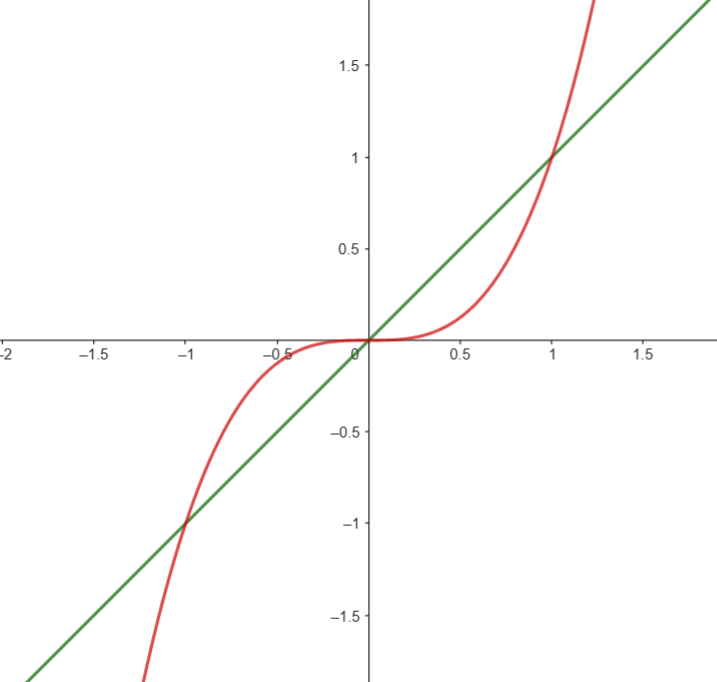 Note that \(x^{3} = 2x \iff x= \pm \sqrt{ 2 } \quad \lor \quad x=0\). Hence the area between the curves is given by
Example
Find the area between the curves \(f(x) = x^{3}, g(x) = 2x\), \(h(x) = x\) for \(0 \leq x \leq \sqrt{ 2 }\).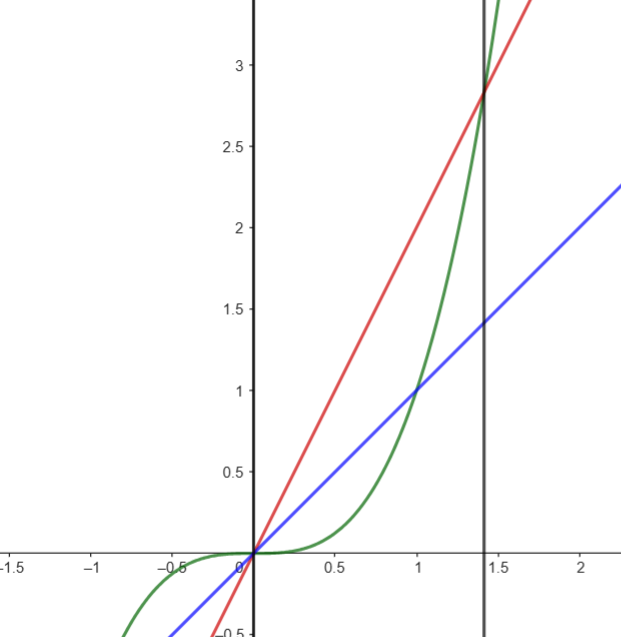 Consider the solution of \(x^{3} = x \iff x=\pm 1 \lor x=0\). Hence the area is given by
Arc length of a curve
Let \(f(x) = \sin(x)\). We want to know the length of the curve, i.e., how long it would measure if we straightened it out. We can approximate the length using rectangles and measuring the segments between the vertices of the rectangles. The length of the segments is given by
\[\sqrt{ (f(a_{i+1})-f(a_{i}))^{2} + (a_{i+1}-a_{i})^{2}}.\]Moreover, if \(f\) is differentiable, then by the mean value theorem there exists \(\xi_{i}\) such that \(f(a_{i+1})-f(a_{i}) = f'(\xi_{i})(a_{i+1}-a_{i})\). Substituting this into the approximation of the segment, its value is given by
\[(a_{i+1}-a_{i}) \sqrt{ (f'(\xi_{i}))^{2} + 1 }.\]Summing over all the intervals, the segments measure
\[\sum_{i=0}^{n-1} (a_{i+1}-a_{i}) \sqrt{ (f'(\xi_{i}))^{2} + 1 } = S(\sqrt{ (f')^{2}+1 }, P, \xi_{1},\dots,\xi_{n}).\]If the sum converges, the length of the curve is
\[\int_{a}^{b} \sqrt{ (f'(x))^{2} + 1 } \, dx .\]The sum converges whenever \(f'\) is continuous.