Here are some useful tools for assessing the convergence of series. See also: Series of functions (Taylor series).
Example
Let \(\alpha \in \mathbb{R}\); then
\[\begin{aligned} \lim_{ n \to \infty } \frac{\ln(n^{\alpha})}{n} &= \alpha \lim_{ n \to \infty } \frac{\ln (n)}{n} \\ &\overset{\text{L'H}}{=} \alpha \lim_{ n \to \infty } \frac{1}{n} \\ &= 0. \end{aligned}\]Asymptotic expansions

Some examples are: 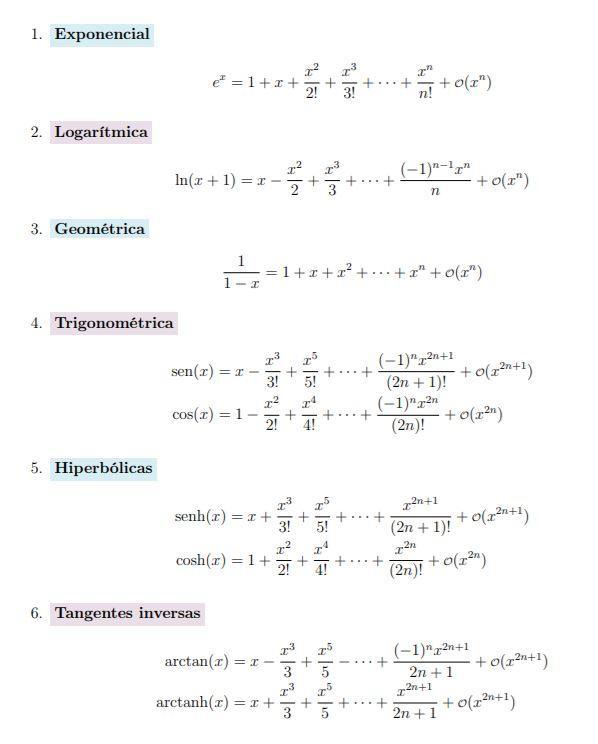
We can approximate functions using Taylor polynomials with asymptotic expansions. For example, \((1+x)^{\alpha} = 1+\alpha x+o(x)\), where we treat the remainder as Landau’s little \(o\) notation, so that \(\lim_{ x \to 0} \frac{o(x)}{x} = 0\). In the same way,
\[(1+x)^{\alpha} = 1 + \alpha x + \frac{\alpha(\alpha-1)}{2} x^{2} + o(x^{2}).\]Now, \(o(x) + o(x^{2}) = o(x)\), since
\[\lim_{ x \to 0 } \frac{o(x^{2})}{x^{2}} x = 0.\]Example:
\[\sqrt{ n^{2}+1 } -\sqrt[3]{n^{3}+1} = \underbrace{ n\left( \left( 1+\frac{1}{n^{2}} \right)^{1/2} - \left( 1+\frac{1}{n^{3}} \right)^{1/3} \right) }_{ \ast }.\]Applying asymptotic expansions, note that
\[\left( 1+\frac{1}{n^{2}} \right)^{1/2} = 1+\frac{1}{2} \cdot \frac{1}{n^{2}} + o\left( \frac{1}{n^{2}} \right),\] \[\left( 1+\frac{1}{n^{3}} \right)^{1/3} = 1 + \frac{1}{3} \cdot\frac{1}{n^{3}} + o\left( \frac{1}{n^{3}} \right).\]Then, substituting into the initial expression,
\[\ast = n\left(\frac{1}{2n^{2}} - \frac{1}{3n^{3}} + o\left( \frac{1}{n^{2}} \right)\right) = \frac{1}{2n} + \frac{1}{3n^{2}} + no\left( \frac{1}{n^{2}} \right) = \frac{1}{2n} + \frac{1}{3n^{2}} + o\left( \frac{1}{n} \right).\]CAREFUL: \(o(x^{2}) = x o(x)\) and \(o(x^{n}) = x o(x^{n-1})\).
Then \(\lim_{ n \to \infty } \frac{\frac{1}{2n} - \frac{1}{3n^{2}} + o\left( \frac{1}{n} \right)}{\frac{1}{n}} = \frac{1}{2}\), so by limit comparison \(\sum_{n=1}^\infty \sqrt{ n^{2}+1 } - \sqrt[3]{n^{3}+1}\) diverges.
Example
Consider \(\sum_{n=1}^\infty \frac{\sqrt{ n^{2}+1 } - \sqrt[3]{n^{3}+1}}{n^{p}}\). For which values of \(p\) does it converge? Note that, by the asymptotic expansion above,
\[\frac{\sqrt{ n^{2}+1 } - \sqrt[3]{n^{3}+1}}{n^{p}} \approx \frac{1}{n^{p}},\]since
\[\lim_{ n \to \infty } \frac{\frac{\sqrt{ n^{2}+1 } - \sqrt[3]{n^{3}+1}}{n^{p}}}{\frac{1}{n^{p+1}}} = \lim_{ n \to \infty } \frac{\frac{1}{2n} - \frac{1}{3n^{2}} + o\left( \frac{1}{n} \right)}{\frac{1}{n}} = \frac{1}{2}.\]Therefore the series converges if and only if \(\sum_{n=q}^\infty \frac{1}{n^{p+1}}\) converges, i.e., if \(p>0\).
Example
Consider the series \(\sum_{n=1}^\infty \frac{\left( 1-\frac{1}{n} \right)^{n}}{n}\). First, note that
\[\left( 1-\frac{1}{n^{2}} \right)^{n} = e^{\ln(1-1/n^{2})^{n}} = e^{n\ln(1-1/n^{2})}.\]Recall that
\[\ln(1+x) = x + o(x) = x - \frac{x^{2}}{2} + o(x).\]Then, to first order, we have that
\[\ln\left( 1-\frac{1}{n^{2}} \right) = -\frac{1}{n^{2}} + o\left( \frac{1}{n^{2}} \right).\]Hence we have that
\[n \ln\left( -\frac{1}{n^{2}}+o\left( \frac{1}{n^{2}} \right) \right) = n\left( -\frac{1}{n^{2}}+o\left( \frac{1}{n^{2}} \right) \right) = -\frac{1}{n} + o\left( \frac{1}{n} \right).\]So \(\left( 1-\frac{1}{n^{2}} \right)^{n} \underset{n \rightarrow \infty}{\longrightarrow} 1\), and therefore, by limit comparison, \(\frac{\left( 1-\frac{1}{n} \right)^{n}}{n} \approx \frac{1}{n}\). Hence the series diverges.
Example
Consider \(\sum_{n=1}^\infty (-1)^{n} e^{-pn}\). For which values of \(p\) does it converge? Note that the series converges absolutely if \(p>0\). If \(p\leq 0\), then \((-1)^{n} e^{-pn} \underset{n \rightarrow \infty}{\cancel{ \longrightarrow }}\) 0, i.e., it diverges.
Example
Consider \(\sum_{n=1}^\infty \frac{n^{n}}{n! 2^{n}}\). Applying the ratio test, note that
\[\lim_{ n \to \infty } \frac{\frac{(n+1)^{n+1}}{(n+1)!2^{n+1}}}{\frac{n^{n}}{n! 2^{n}}} = \lim_{ n \to \infty } (\frac{(n+1)^{n+1}}{2(n+1)n^{n}} = \frac{1}{2}\lim_{ n \to \infty } \left( \frac{n+1}{n} \right)^{n} = \frac{e}{2} > 1.\]Hence the series diverges.
Stirling’s formula
\[\lim_{ n \to \infty } \frac{n!}{\left( \frac{n}{e} \right)^{n} \sqrt{ 2 \pi n }} = 1 \implies n! \approx \left( \frac{n}{e} \right)^{n} \sqrt{ 2 \pi n }.\]Example
In the previous example,
\[\frac{n^{n}}{2^{n}n!} \approx \left( \frac{e}{2} \right)^{n} \frac{1}{\sqrt{ 2\pi n }}\]Example
Let \(a_{n}\geq_{0}\) be such that \(\sum_{n=1}^\infty a_{n}\) converges. Does the series \(\sum_{n=1}^\infty a_{n}^{3}\) converge? Note that
\[\lim_{ n \to \infty } \frac{a_{n}^{3}}{a_{n}} = \lim_{ n \to \infty } a_{n}^{2} = 0.\]Another way to see it is that \(a_{n}^{3} \leq a_{n}\) whenever \(a_{n} < 1\).
Example
Consider \(\sum_{n=1}^\infty (-1)^{n} (1+\frac{1}{n})\). Note that the terms do not converge to zero, since \(\lim_{ n \to \infty } (-1)^{n}\left( 1+\frac{1}{n} \right) = 1\). Therefore the series diverges.
Example
Consider \(\sum_{n=1}^\infty \sinh(n) = \sum_{n=1}^\infty \frac{e^{n} - e^{-n}}{2}\). The series diverges, since \(\sum_{n=1}^\infty \frac{e^{n}}{2}\) diverges and \(\sum_{n=1}^\infty e^{-n}\) converges. 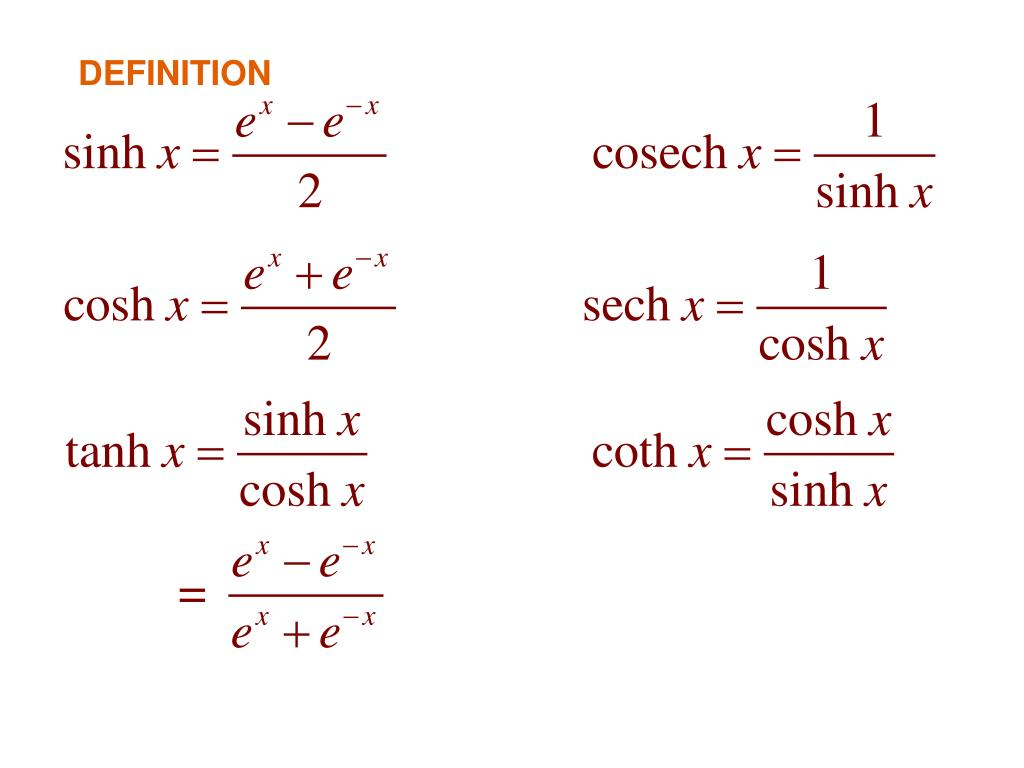
Example
Compute the value that the series \(\sum_{n=0}^\infty n(n-1)x^{n}\) converges to, with \(\lvert x \rvert < 1\).
The arctangent formula
This formula is useful for computing series involving the arctangent.
\[\arctan\left( \frac{x-y}{1+xy} \right) = \arctan(x) - \arctan(y).\]Trigonometric inequalities.
For every \(x \in \mathbb{R}\), we have that
\[\lvert \sin(x) \rvert \leq \lvert x \rvert \leq \lvert \tan(x) \rvert .\]If \(x < \frac{\pi}{2}\)
\[\sin(x) > \frac{x}{2}\]Definition of supremum and infimum