Motivation: length of curves and mass of a wire
Two geometric problems show the need to enlarge the class of functions that can be treated with the Riemann integral. Consider a continuous curve \(\gamma : [a,b] \to \mathbb{R}^{2}\), \(\gamma(t) = (\gamma_{1}(t), \gamma_{2}(t))\). Given a partition \(a = t_{0} < t_{1} < \dots < t_{n} = b\), the polygonal path with vertices \(\gamma(t_{i})\) approximates the curve, and its length is
\[\sum_{i=0}^{n-1} \|\gamma(t_{i+1}) - \gamma(t_{i})\|.\]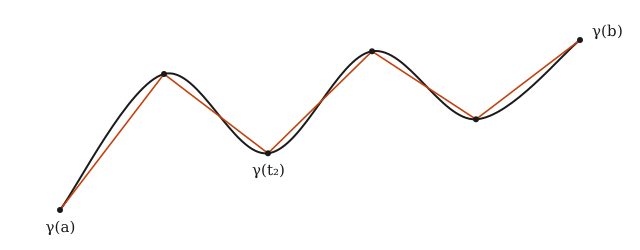
| If \(\gamma_{1}, \gamma_{2}\) are differentiable with Riemann-integrable derivative, the mean value theorem suggests that the length is \(\int_{a}^{b} |\gamma'(t)|\,dt\); but in general it is not even clear that the set of polygonal lengths is bounded. An analogous phenomenon appears when computing the mass of a wire of density \(\rho\), which is approximated by sums \(\sum_{i} \rho(t_{i})\, A\, |\gamma(t_{i+1}) - \gamma(t_{i})|\). In both cases the relevant quantity is the supremum of the sums of increments $$\sum | f(t_{i+1}) - f(t_{i}) | $$ over all partitions; the functions for which that supremum is finite are the subject of this section. |
Definition and first examples
Definition (Function of bounded variation and sum of increments)
Let \(f : [a,b] \to \mathbb{R}\). For a partition \(\Gamma = \{ a = t_{0} < t_{1} < \dots < t_{n} = b\}\) we define the sum of increments
\[S(f, \Gamma) = \sum_{i=0}^{n-1} |f(t_{i+1}) - f(t_{i})|.\]We say that \(f\) is of bounded variation if there exists \(M > 0\) such that \(S(f, \Gamma) \leq M\) for every partition \(\Gamma\); equivalently, if
\[\sup_{\Gamma} S(f, \Gamma) < \infty.\]Example (Every monotone function is of bounded variation)
If \(f\) is increasing, the increments \(f(t_{i+1}) - f(t_{i})\) are non-negative and the sum telescopes:
\[S(f, \Gamma) = \sum_{i=0}^{n-1} \big(f(t_{i+1}) - f(t_{i})\big) = f(b) - f(a).\]Analogously, if \(f\) is decreasing, \(S(f, \Gamma) = f(a) - f(b)\) for every \(\Gamma\). In both cases \(S(f, \Gamma)\) does not depend on \(\Gamma\), so that \(f\) is of bounded variation.
Example (The indicator of the irrationals is not of bounded variation)
| Let \(\varphi : [0,1] \to \mathbb{R}\) with \(\varphi(x) = 0\) if \(x \in \mathbb{Q}\) and \(\varphi(x) = 1\) if \(x \notin \mathbb{Q}\). Given \(n\), choose a partition \(\{x_{k}\}_{k=0}^{2n}\) with \(x_{0} = 0\), \(x_{2n} = 1\), \(x_{2k} \in \mathbb{Q}\) and \(x_{2k+1} \notin \mathbb{Q}\). Each increment $$ | \varphi(x_{k+1}) - \varphi(x_{k}) | \(equals\)1$$, so that |
Since \(n\) is arbitrary, \(\sup_{\Gamma} S(\varphi, \Gamma) = \infty\) and \(\varphi\) is not of bounded variation.
The total variation
Definition (Total variation)
If \(f : [a,b] \to \mathbb{R}\) is of bounded variation, its total variation over \([a,b]\) is
\[\operatorname{Var}(f, [a,b]) = \sup_{\Gamma} S(f, \Gamma).\]Proposition (Monotonicity of the variation over subintervals)
Let \(f : [a,b] \to \mathbb{R}\) be of bounded variation and \([a_{1}, b_{1}] \subseteq [a,b]\). Then the restriction of \(f\) to \([a_{1}, b_{1}]\) is of bounded variation and
\[\operatorname{Var}(f, [a_{1}, b_{1}]) \leq \operatorname{Var}(f, [a,b]).\]Proof: Let \(\Gamma_{1}\) be a partition of \([a_{1}, b_{1}]\) and consider the partition \(\Gamma = \Gamma_{1} \cup \{a, b\}\) of \([a,b]\). Adding the endpoints only adds non-negative summands, so that
\[S(f, \Gamma_{1}) \leq S(f, \Gamma_{1}) + |f(a_{1}) - f(a)| + |f(b) - f(b_{1})| = S(f, \Gamma) \leq \operatorname{Var}(f, [a,b]).\]Taking the supremum over \(\Gamma_{1}\) we obtain \(\operatorname{Var}(f, [a_{1}, b_{1}]) \leq \operatorname{Var}(f, [a,b]) < \infty\).
Proposition (Functions of bounded variation are bounded)
If \(f : [a,b] \to \mathbb{R}\) is of bounded variation, then for every \(x \in [a,b]\)
\[2|f(x)| \leq \operatorname{Var}(f, [a,b]) + |f(a)| + |f(b)|.\]In particular \(f\) is bounded.
Proof: For \(x \in (a,b)\), the partition \(\{a, x, b\}\) gives
\[|f(x) - f(a)| + |f(b) - f(x)| \leq \operatorname{Var}(f, [a,b]).\]| By the reverse triangle inequality, $$ | f(x) | - | f(a) | \leq | f(x) - f(a) | \(and\) | f(x) | - | f(b) | \leq | f(b) - f(x) | $$. Adding, |
| which is the desired inequality (trivial at \(x = a, b\)). Hence $$ | f(x) | \leq \tfrac{1}{2}\big(\operatorname{Var}(f,[a,b]) + | f(a) | + | f(b) | \big)\(for every\)x$$. |
Lemma (Algebraic properties of functions of bounded variation)
Let \(f, g : [a,b] \to \mathbb{R}\) be of bounded variation. Then:
- \(cf + g\) is of bounded variation for every \(c \in \mathbb{R}\);
- \(fg\) is of bounded variation;
-
if there exists \(\varepsilon > 0\) with $$ g(x) \geq \varepsilon\(for every\)x \in [a,b]\(, then\)1/g$$ is of bounded variation; - \(f\) and \(g\) are bounded.
Proof: Exercise.
Lemma (Additivity of the variation over subintervals)
Let \(f : [a,b] \to \mathbb{R}\) be of bounded variation and \(a < c < b\). Then
\[\operatorname{Var}(f, [a,b]) = \operatorname{Var}(f, [a,c]) + \operatorname{Var}(f, [c,b]).\]Proof: (\(\leq\)). Let \(\Gamma = \{a = x_{0} < \dots < x_{n} = b\}\) and let \(\Gamma' = \Gamma \cup \{c\}\), with \(x_{m_{0}} \leq c < x_{m_{0}+1}\). Refining by adding \(c\) does not decrease the sum of increments:
\[S(f, \Gamma) \leq S(f, \Gamma') = S(f, \Gamma_{1}) + S(f, \Gamma_{2}),\]where \(\Gamma_{1} = (\Gamma' \cap [a,c]) \cup \{c\}\) and \(\Gamma_{2} = \{c\} \cup (\Gamma' \cap [c,b])\) are partitions of \([a,c]\) and \([c,b]\) respectively. Hence \(S(f, \Gamma) \leq \operatorname{Var}(f, [a,c]) + \operatorname{Var}(f, [c,b])\), and taking the supremum over \(\Gamma\),
\[\operatorname{Var}(f, [a,b]) \leq \operatorname{Var}(f, [a,c]) + \operatorname{Var}(f, [c,b]).\](\(\geq\)). If \(\Gamma_{1}\) and \(\Gamma_{2}\) are partitions of \([a,c]\) and \([c,b]\), then \(\Gamma = \Gamma_{1} \cup \Gamma_{2}\) is a partition of \([a,b]\) and \(S(f, \Gamma_{1}) + S(f, \Gamma_{2}) = S(f, \Gamma) \leq \operatorname{Var}(f, [a,b])\). Taking the supremum first in \(\Gamma_{1}\) and then in \(\Gamma_{2}\),
\[\operatorname{Var}(f, [a,c]) + \operatorname{Var}(f, [c,b]) \leq \operatorname{Var}(f, [a,b]).\]The Jordan decomposition
Notation (Positive and negative part; positive and negative variations)
For \(x \in \mathbb{R}\) we define \(x^{+} = \max\{x, 0\}\) and \(x^{-} = \max\{-x, 0\}\); both are non-negative and
\[x^{+} + x^{-} = |x|, \qquad x^{+} - x^{-} = x.\]Given \(f : [a,b] \to \mathbb{R}\) and a partition \(\Gamma = \{a = t_{0} < \dots < t_{n} = b\}\), we define
\[P(f, \Gamma) = \sum_{i=0}^{n-1} \big(f(t_{i+1}) - f(t_{i})\big)^{+}, \qquad N(f, \Gamma) = \sum_{i=0}^{n-1} \big(f(t_{i+1}) - f(t_{i})\big)^{-},\]and the positive and negative variations \(P(f, [a,b]) = \sup_{\Gamma} P(f, \Gamma)\), \(N(f, [a,b]) = \sup_{\Gamma} N(f, \Gamma)\).
Lemma (Relation between the total variation and the positive and negative variations)
Let \(f : [a,b] \to \mathbb{R}\) be of bounded variation. Then
\[P(f, [a,b]) - N(f, [a,b]) = f(b) - f(a), \qquad P(f, [a,b]) + N(f, [a,b]) = \operatorname{Var}(f, [a,b]).\]Equivalently,
\[P(f, [a,b]) = \tfrac{1}{2}\big(\operatorname{Var}(f, [a,b]) + f(b) - f(a)\big), \quad N(f, [a,b]) = \tfrac{1}{2}\big(\operatorname{Var}(f, [a,b]) - f(b) + f(a)\big).\]| Proof: For each partition \(\Gamma\), using $$x^{+} + x^{-} = | x | \(and\)x^{+} - x^{-} = x$$ on each increment, |
From the second identity, \(f(a) + P(f, \Gamma) = f(b) + N(f, \Gamma)\); since the left-hand side and the right-hand side differ by the constant \(f(b) - f(a)\), taking the supremum in \(\Gamma\) gives \(f(a) + P(f, [a,b]) = f(b) + N(f, [a,b])\), that is, \(P(f, [a,b]) - N(f, [a,b]) = f(b) - f(a)\). Moreover, from \(P(f,\Gamma) - N(f,\Gamma) = f(b) - f(a)\) we obtain \(S(f, \Gamma) = 2P(f, \Gamma) - (f(b) - f(a))\); taking the supremum,
\[\operatorname{Var}(f, [a,b]) = 2P(f, [a,b]) - (f(b) - f(a)),\]and combining with \(P - N = f(b) - f(a)\) we obtain \(P + N = \operatorname{Var}(f, [a,b])\) and the closed formulas for \(P\) and \(N\).
Theorem (Jordan’s characterisation of bounded variation)
A function \(f : [a,b] \to \mathbb{R}\) is of bounded variation if and only if \(f\) is the difference of two increasing functions. Moreover, the functions may be taken non-negative.
Proof: (\(\Rightarrow\)). Define \(P(x) = P(f, [a,x])\) and \(N(x) = N(f, [a,x])\) (with \(P(a) = N(a) = 0\)). By the previous lemma applied to \([a,x]\),
\[f(x) - f(a) = P(x) - N(x), \qquad \text{that is} \qquad f(x) = \big(f(a) + P(x)\big) - N(x).\]By the monotonicity of the variation over subintervals, \(P\) and \(N\) are increasing and non-negative. Choosing a constant \(c \geq \max\{0, -f(a)\}\), the functions \(g = c + f(a) + P\) and \(h = c + N\) are increasing, non-negative and \(f = g - h\).
(\(\Leftarrow\)). If \(f = g - h\) with \(g, h\) increasing, then \(g\) and \(h\) are of bounded variation (every monotone function is) and, by the lemma on algebraic properties, so is \(f = g - h\).
Discontinuities and refinement of partitions
Theorem (Functions of bounded variation have at most countably many discontinuities)
Let \(f : [a,b] \to \mathbb{R}\) be of bounded variation. Then \(f\) has at most countably many discontinuities, and each one is a jump or a removable discontinuity (that is, the one-sided limits \(f(x^{+})\) and \(f(x^{-})\) exist at every point).
Proof: By Jordan’s characterisation, \(f = f_{1} - f_{2}\) with \(f_{1}, f_{2}\) increasing; it suffices to prove the statement for an increasing function \(g\), since the union of two countable sets is countable and the one-sided limits of \(g\) exist by monotonicity. For \(k \geq 1\) let
\[D_{k} = \big\{ x \in [a,b] : g(x^{+}) - g(x^{-}) \geq \tfrac{1}{k}\big\}.\]If \(x_{0} < x_{1} < \dots < x_{m}\) are points of \(D_{k}\), one may interleave \(y_{i}, z_{i}\) with \(y_{i} < x_{i} < z_{i} = y_{i+1}\), so that the jumps at the \(x_{i}\) are dominated by disjoint increments of \(g\):
\[\frac{m+1}{k} \leq \sum_{i=0}^{m} \big(g(z_{i}) - g(y_{i})\big) \leq g(b) - g(a).\]Therefore \(D_{k}\) is finite, with at most \(k\,(g(b) - g(a))\) elements. The set of discontinuities of \(g\) is \(\bigcup_{k \geq 1} D_{k}\), a countable union of finite sets, hence countable.
Theorem (Approximation of the total variation by fine partitions)
Let \(f : [a,b] \to \mathbb{R}\) be continuous and of bounded variation, and let \(V = \operatorname{Var}(f, [a,b])\). For every \(M < V\) there exists \(\delta > 0\) such that
\[M < S(f, \Gamma) \leq V \qquad \text{for every partition } \Gamma \text{ with } |\Gamma| < \delta,\]| where $$ | \Gamma | \(denotes the norm (largest subinterval length) of\)\Gamma$$. |
Proof: The bound \(S(f, \Gamma) \leq V\) is the definition of \(V\). Fix \(\mu > 0\) with \(M + \mu < V\) and a partition \(\Gamma_{1} = \{a = \tilde{x}_{0} < \dots < \tilde{x}_{k} = b\}\) such that \(M + \mu < S(f, \Gamma_{1})\). Since \(f\) is uniformly continuous, there exists \(\delta_{1} > 0\) with
\[|x - y| < \delta_{1} \implies |f(x) - f(y)| < \frac{\mu}{2(k+1)}.\]| Let $$\gamma = \min_{0 \leq j \leq k-1} | \tilde{x}{j+1} - \tilde{x}{j} | \(and take any\)\Gamma\(with\) | \Gamma | < \min{\delta_{1}, \gamma}\(. Then each subinterval of\)\Gamma\(contains at most one point of\)\Gamma_{1}\(. Let\)\Gamma_{2} = \Gamma \cup \Gamma_{1}\(; in passing from\)\Gamma\(to\)\Gamma_{2}\(at most\)k+1\(points are inserted, and each insertion of a point\)\tilde{x}\(into a subinterval\)[x_{j-1}, x_{j}]\(replaces\) | f(x_{j}) - f(x_{j-1}) | \(by\) | f(x_{j}) - f(\tilde{x}) | + | f(\tilde{x}) - f(x_{j-1}) | \(, increasing the sum by at most\)2\cdot \frac{\mu}{2(k+1)}$$. Therefore |
Since \(\Gamma_{2}\) refines \(\Gamma_{1}\), \(S(f, \Gamma_{1}) \leq S(f, \Gamma_{2})\), whence
\[M < S(f, \Gamma_{1}) - \mu \leq S(f, \Gamma_{2}) - \mu \leq S(f, \Gamma).\]Corollary (Total variation and derivative)
Let \(f : [a,b] \to \mathbb{R}\) with \(f'\) continuous on \([a,b]\). Then
\[\operatorname{Var}(f, [a,b]) = \int_{a}^{b} |f'(x)|\,dx, \qquad P(f, [a,b]) = \int_{a}^{b} \big(f'(x)\big)^{+} dx, \qquad N(f, [a,b]) = \int_{a}^{b} \big(f'(x)\big)^{-} dx.\]Proof: Exercise.