Closed sets, complements and the sigma-algebra of measurable sets
Exercise (Decomposition of an open set into almost disjoint boxes)
Prove that every open set \(G \subseteq \mathbb{R}^{d}\) can be written as \(G = \bigcup_{k=1}^{\infty} I_{k}\), with \(I_{k} = [a_{1}^{k}, b_{1}^{k}] \times \dots \times [a_{d}^{k}, b_{d}^{k}]\) closed boxes with pairwise disjoint interiors.
Theorem (Every closed set is measurable)
Let \(F \subseteq \mathbb{R}^{d}\) be closed. Then \(F\) is measurable.
Proof: Compact case. Suppose first that \(F\) is compact, so that \(m_{e}(F) < \infty\). Given \(\varepsilon > 0\), by approximation there exists an open set \(G \supseteq F\) with \(m_{e}(G) \leq m_{e}(F) + \tfrac{\varepsilon}{2}\). The open set \(G \setminus F\) decomposes as a countable union of closed boxes \(\{I_{k}\}\) with disjoint interiors. For each \(\ell\), the disjoint compact sets \(F\) and \(\bigcup_{k=1}^{\ell} I_{k}\) are at positive distance, hence by additivity at positive distance
\[m_{e}(F) + m_{e}\Big(\bigcup_{k=1}^{\ell} I_{k}\Big) = m_{e}\Big(F \cup \bigcup_{k=1}^{\ell} I_{k}\Big) \leq m_{e}(G),\]whence \(\sum_{k=1}^{\ell} m_{e}(I_{k}) = m_{e}\big(\bigcup_{k=1}^{\ell} I_{k}\big) \leq m_{e}(G) - m_{e}(F) \leq \tfrac{\varepsilon}{2}\) for every \(\ell\). Therefore \(\sum_{k=1}^{\infty} m_{e}(I_{k}) \leq \tfrac{\varepsilon}{2}\) and, by subadditivity, \(m_{e}(G \setminus F) \leq \sum_{k} m_{e}(I_{k}) < \varepsilon\). Thus \(F\) is measurable.
General case. If \(F\) is an arbitrary closed set, \(F = \bigcup_{k=1}^{\infty} F_{k}\) with \(F_{k} = F \cap \overline{B(0,k)}\) compact; each \(F_{k}\) is measurable and, being a countable union of measurable sets, \(F\) is measurable.
Theorem (The complement of a measurable set is measurable)
If \(E \subseteq \mathbb{R}^{d}\) is measurable, then \(E^{c}\) is measurable.
Proof: For each \(k \geq 1\) there exists an open set \(G_{k} \supseteq E\) with \(m_{e}(G_{k} \setminus E) < \tfrac{1}{k}\). Each \(G_{k}^{c}\) is closed, hence measurable, and \(H = \bigcup_{k} G_{k}^{c}\) is measurable with
\[H = \bigcup_{k} G_{k}^{c} = \Big(\bigcap_{k} G_{k}\Big)^{c} \subseteq E^{c}.\]Moreover \(E^{c} \setminus H \subseteq E^{c} \setminus G_{k}^{c} = E^{c} \cap G_{k} = G_{k} \setminus E\), so that \(m_{e}(E^{c} \setminus H) \leq \tfrac{1}{k}\) for every \(k\); hence \(Z = E^{c} \setminus H\) has outer measure zero (and is measurable). Finally \(E^{c} = H \cup Z\) is a union of measurable sets, hence measurable.
Definition (\(\sigma\)-algebra)
Let \(\Omega\) be a set. A \(\sigma\)-algebra \(\mathcal{F} \subseteq 2^{\Omega}\) satisfies:
- \(\Omega \in \mathcal{F}\);
- if \(E \in \mathcal{F}\), then \(E^{c} \in \mathcal{F}\);
- if \(\{F_{k}\}_{k=1}^{\infty} \subseteq \mathcal{F}\), then \(\bigcup_{k} F_{k} \in \mathcal{F}\).
Lemma (Closure of a \(\sigma\)-algebra under intersections and differences)
Let \(\mathcal{F}\) be a \(\sigma\)-algebra and \(\{E_{k}\}_{k=1}^{\infty} \subseteq \mathcal{F}\). Then \(\bigcap_{k} E_{k} \in \mathcal{F}\), \(E_{1} \setminus E_{2} \in \mathcal{F}\) and \(\emptyset \in \mathcal{F}\).
Proof: Exercise.
Lemma (The measurable sets form a \(\sigma\)-algebra)
The family \(\mathcal{M} = \{E \subseteq \mathbb{R}^{d} : E \text{ measurable}\}\) is a \(\sigma\)-algebra.
Proof: \(\mathbb{R}^{d}\) is open, hence measurable. Closure under complement and under countable union are the two preceding theorems. Therefore \(\mathcal{M}\) satisfies the three conditions; in particular it contains countable intersections and differences \(E_{1} \setminus E_{2} = E_{1} \cap E_{2}^{c}\) of measurable sets.
Definition (Generated \(\sigma\)-algebra)
Given \(\mathcal{S} \subseteq 2^{\Omega}\), the \(\sigma\)-algebra generated by \(\mathcal{S}\) is
\[\sigma(\mathcal{S}) = \bigcap_{\substack{\mathcal{F}\ \sigma\text{-algebra} \\ \mathcal{S} \subseteq \mathcal{F}}} \mathcal{F},\]the smallest \(\sigma\)-algebra containing \(\mathcal{S}\) (the intersection of \(\sigma\)-algebras is a \(\sigma\)-algebra).
Borel sets and characterisation by closed sets
Definition (Borel \(\sigma\)-algebra)
The Borel \(\sigma\)-algebra \(\mathcal{B}\) is the \(\sigma\)-algebra generated by the open subsets of \(\mathbb{R}^{d}\). Being a \(\sigma\)-algebra, \(\mathcal{B}\) contains the closed sets, the \(G_{\delta}\) and \(F_{\sigma}\) sets, and \(\mathcal{B} \subseteq \mathcal{M}\).
Lemma (Characterisation of measurability by inner closed sets)
Let \(E \subseteq \mathbb{R}^{d}\). Then \(E\) is measurable if and only if for every \(\varepsilon > 0\) there exists a closed set \(F \subseteq E\) with \(m_{e}(E \setminus F) < \varepsilon\).
Proof: \(E\) is measurable if and only if \(E^{c}\) is. Given \(\varepsilon > 0\), if \(E^{c}\) is measurable there exists an open set \(G \supseteq E^{c}\) with \(m_{e}(G \setminus E^{c}) < \varepsilon\). Take \(F = G^{c}\), which is closed and \(F \subseteq E\). Then
\[m_{e}(E \setminus F) = m_{e}(E \cap F^{c}) = m_{e}(E \cap G) = m_{e}(G \setminus E^{c}) < \varepsilon.\]Conversely, if such closed sets \(F \subseteq E\) exist, then their open complements \(F^{c} \supseteq E^{c}\) satisfy \(m_{e}(F^{c} \setminus E^{c}) = m_{e}(E \setminus F) < \varepsilon\), so that \(E^{c}\) is measurable and therefore so is \(E\).
sigma-additivity and continuity of the measure
Theorem (\(\sigma\)-additivity of Lebesgue measure)
Let \(\{E_{k}\}_{k=1}^{\infty}\) be a countable family of pairwise disjoint measurable sets. Then
\[m\left(\bigcup_{k=1}^{\infty} E_{k}\right) = \sum_{k=1}^{\infty} m(E_{k}).\]Proof: The inequality \(\leq\) is subadditivity. For \(\geq\), suppose first that each \(E_{k}\) is bounded. Given \(\varepsilon > 0\), by the characterisation by closed sets there exists a closed (and bounded, hence compact) set \(F_{k} \subseteq E_{k}\) with \(m(E_{k} \setminus F_{k}) < \varepsilon/2^{k}\). The \(F_{k}\) are disjoint compact sets, hence pairwise at positive distance, and by additivity at positive distance (and induction),
\[\sum_{i=1}^{m} m(F_{i}) = m\Big(\bigcup_{i=1}^{m} F_{i}\Big) \leq m\Big(\bigcup_{i=1}^{\infty} E_{i}\Big) \qquad \text{for every } m,\]whence \(\sum_{i=1}^{\infty} m(F_{i}) \leq m\big(\bigcup_{i} E_{i}\big)\). Since \(m(E_{k}) \leq m(F_{k}) + \varepsilon/2^{k}\),
\[\sum_{i=1}^{\infty} m(E_{i}) - \varepsilon \leq \sum_{i=1}^{\infty} m(F_{i}) \leq m\Big(\bigcup_{i} E_{i}\Big),\]and letting \(\varepsilon \to 0\) one obtains \(\sum_{i} m(E_{i}) \leq m\big(\bigcup_{i} E_{i}\big)\). The general case (unbounded sets) reduces to this one by splitting each \(E_{k}\) into the annuli \(E_{k} \cap (\overline{B(0,n)} \setminus B(0,n-1))\) and is left as an exercise.
Note (Monotonicity and subtraction of measures)
If \(E_{1} \subseteq E_{2}\) are measurable, then \(m(E_{2}) = m(E_{1}) + m(E_{2} \setminus E_{1})\); in particular \(m(E_{1}) \leq m(E_{2})\), and if \(m(E_{1}) < \infty\),
\[m(E_{2} \setminus E_{1}) = m(E_{2}) - m(E_{1}).\]Theorem (Continuity of the measure)
Let \(\{E_{k}\}_{k=1}^{\infty}\) be a sequence of measurable sets.
- If \(E_{i} \subseteq E_{i+1}\) for every \(i\), then \(\displaystyle m\Big(\bigcup_{i=1}^{\infty} E_{i}\Big) = \lim_{k \to \infty} m(E_{k})\).
- If \(E_{i+1} \subseteq E_{i}\) for every \(i\) and there exists \(i_{0}\) with \(m(E_{i_{0}}) < \infty\), then \(\displaystyle m\Big(\bigcap_{i=1}^{\infty} E_{i}\Big) = \lim_{i \to \infty} m(E_{i})\).
Proof: (i). With \(E_{0} = \emptyset\), the sets \(E_{i} \setminus E_{i-1}\) are measurable, disjoint and \(\bigcup_{i} E_{i} = \bigsqcup_{i} (E_{i} \setminus E_{i-1})\). By \(\sigma\)-additivity and telescoping,
\[m\Big(\bigcup_{i} E_{i}\Big) = \sum_{i=1}^{\infty} m(E_{i} \setminus E_{i-1}) = \lim_{n \to \infty}\sum_{i=1}^{n}\big(m(E_{i}) - m(E_{i-1})\big) = \lim_{n \to \infty} m(E_{n}),\]where the telescoping is valid when the \(m(E_{i})\) are finite; if some \(m(E_{n}) = \infty\), both sides equal \(\infty\) by monotonicity.
(ii). Discarding the first terms one may suppose \(i_{0} = 1\), so that \(m(E_{i}) \leq m(E_{1}) < \infty\) for every \(i\). Let \(E = \bigcap_{i} E_{i}\). Then \(E_{1} = E \sqcup \bigsqcup_{i \geq 1}(E_{i} \setminus E_{i+1})\), so that
\[m(E_{1}) = m(E) + \sum_{i=1}^{\infty}\big(m(E_{i}) - m(E_{i+1})\big) = m(E) + \lim_{n \to \infty}\big(m(E_{1}) - m(E_{n})\big) = m(E) + m(E_{1}) - \lim_{n} m(E_{n}).\]Since \(m(E_{1}) < \infty\) it cancels, and \(m(E) = \lim_{n} m(E_{n})\).
Example (Finiteness is necessary for continuity from above)
The hypothesis \(m(E_{i_{0}}) < \infty\) cannot be omitted: with \(E_{k} = [-k, k]^{c} \subseteq \mathbb{R}\) we have \(E_{k+1} \subseteq E_{k}\), \(m(E_{k}) = \infty\) for every \(k\), but \(\bigcap_{k} E_{k} = \emptyset\), so that \(m\big(\bigcap_{k} E_{k}\big) = 0 \neq \infty = \lim_{k} m(E_{k})\).
Theorem (Outer continuity from below for arbitrary sets)
If \(E_{k} \subseteq E_{k+1} \subseteq \mathbb{R}^{d}\) for every \(k\) (without assuming them measurable), then
\[m_{e}\left(\bigcup_{k=1}^{\infty} E_{k}\right) = \lim_{k \to \infty} m_{e}(E_{k}).\]Proof: For each \(k\) take a \(G_{\delta}\) set, \(G_{k} \supseteq E_{k}\), with \(m_{e}(E_{k}) = m(G_{k})\). The \(G_{k}\) need not be nested, so one defines \(V_{k} = \bigcap_{j=k}^{\infty} G_{j}\), which is measurable and satisfies \(V_{k} \subseteq V_{k+1}\). Since \(E_{k} \subseteq E_{k+\ell} \subseteq G_{k+\ell}\) for every \(\ell \geq 0\), it follows that \(E_{k} \subseteq \bigcap_{j \geq k} G_{j} = V_{k}\). By monotonicity, \(m_{e}(E_{k}) \leq m(V_{k}) \leq m(G_{k}) = m_{e}(E_{k})\), hence \(m(V_{k}) = m_{e}(E_{k})\). Finally, using \(\bigcup_{k} E_{k} \subseteq \bigcup_{k} V_{k}\) and continuity from below (for the measurable sets \(V_{k}\)),
\[m_{e}\Big(\bigcup_{k} E_{k}\Big) \leq m\Big(\bigcup_{k} V_{k}\Big) = \lim_{k \to \infty} m(V_{k}) = \lim_{k \to \infty} m_{e}(E_{k}).\]The opposite inequality is monotonicity: \(m_{e}(E_{m}) \leq m_{e}\big(\bigcup_{k} E_{k}\big)\) for every \(m\), hence \(\lim_{m} m_{e}(E_{m}) \leq m_{e}\big(\bigcup_{k} E_{k}\big)\).
Characterisations of measurability
Theorem (Characterisation by \(G_{\delta}\) and \(F_{\sigma}\) modulo measure zero)
Let \(E \subseteq \mathbb{R}^{d}\). The following conditions are equivalent:
- \(E\) is measurable;
- \(E = H \setminus Z\), where \(H\) is of type \(G_{\delta}\) and \(m_{e}(Z) = 0\);
- \(E = H \cup Z\), where \(H\) is of type \(F_{\sigma}\) and \(m_{e}(Z) = 0\).
Proof: \((ii) \Rightarrow (i)\) and \((iii) \Rightarrow (i)\) are immediate, since \(G_{\delta}\) and \(F_{\sigma}\) sets are measurable and so are those of outer measure zero, and \(\mathcal{M}\) is closed under differences and unions. We prove \((i) \Rightarrow (ii)\). If \(E\) is measurable, for each \(k\) there exists an open set \(G_{k} \supseteq E\) with \(m_{e}(G_{k} \setminus E) < \tfrac{1}{k}\). Let \(H = \bigcap_{k} G_{k}\), of type \(G_{\delta}\) with \(E \subseteq H\). Then \(m_{e}(H \setminus E) \leq m_{e}(G_{k} \setminus E) < \tfrac{1}{k}\) for every \(k\), hence \(m_{e}(H \setminus E) = 0\) and \(E = H \setminus Z\) with \(Z = H \setminus E\). The implication \((i) \Rightarrow (iii)\) is analogous (using the characterisation by inner closed sets) and is left as an exercise.
Exercise (Characterisation by almost-unions of intervals)
Let \(E \subseteq \mathbb{R}^{d}\) with \(m_{e}(E) < \infty\). Prove that \(E\) is measurable if and only if for every \(\varepsilon > 0\) there exist \(\widetilde{S}, N_{1}, N_{2}\) such that \(E = (\widetilde{S} \cup N_{1}) \setminus N_{2}\), with \(\widetilde{S} = \bigcup_{k} I_{k}\) (\(I_{k} \in S_{d}\)), \(m_{e}(N_{1}) < \varepsilon\) and \(m_{e}(N_{2}) < \varepsilon\).
Theorem (Carathéodory criterion)
\(E \subseteq \mathbb{R}^{d}\) is measurable if and only if for every \(A \subseteq \mathbb{R}^{d}\)
\[m_{e}(A) = m_{e}(A \cap E) + m_{e}(A \setminus E).\]Proof: (\(\Rightarrow\)). Let \(E\) be measurable and \(A \subseteq \mathbb{R}^{d}\). Take a \(G_{\delta}\) set, \(H \supseteq A\), with \(m_{e}(A) = m(H)\). Since \(H\) and \(E\) are measurable, \(H \cap E\) and \(H \setminus E\) are measurable, disjoint and their union is \(H\), so that \(m(H) = m(H \cap E) + m(H \setminus E)\). Using \(A \cap E \subseteq H \cap E\) and \(A \setminus E \subseteq H \setminus E\),
\[m_{e}(A) = m(H) = m(H \cap E) + m(H \setminus E) \geq m_{e}(A \cap E) + m_{e}(A \setminus E).\]The opposite inequality is subadditivity, so there is equality.
(\(\Leftarrow\)). Suppose that the identity holds for every \(A\). If \(m_{e}(E) < \infty\), take a \(G_{\delta}\) set, \(H \supseteq E\), with \(m(H) = m_{e}(E)\) and apply the hypothesis to \(A = H\): since \(E \subseteq H\), \(H \cap E = E\) and
\[m_{e}(H) = m_{e}(E) + m_{e}(H \setminus E),\]whence \(m_{e}(H \setminus E) = 0\). Then \(H \setminus E\) is measurable and \(E = H \setminus (H \setminus E)\) is measurable. If \(m_{e}(E) = \infty\), let \(E_{k} = E \cap B(0,k)\) and let \(H_{k}\) be a \(G_{\delta}\) set with \(E_{k} \subseteq H_{k}\), \(m(H_{k}) = m_{e}(E_{k})\). Applying the hypothesis to \(A = H_{k}\) and using \(E_{k} \subseteq H_{k} \cap E\),
\[m_{e}(H_{k}) = m_{e}(H_{k} \cap E) + m_{e}(H_{k} \setminus E) \geq m_{e}(E_{k}) + m_{e}(H_{k} \setminus E),\]and since \(m_{e}(H_{k}) = m_{e}(E_{k})\), it follows that \(m_{e}(H_{k} \setminus E) = 0\). With \(H = \bigcup_{k} H_{k}\) (measurable, \(E \subseteq H\)) we have \(m_{e}(H \setminus E) \leq \sum_{k} m_{e}(H_{k} \setminus E) = 0\), hence \(E = H \setminus Z\) with \(Z = H \setminus E\) of measure zero, and \(E\) is measurable.
Corollary (Additivity with respect to a measurable set)
Let \(E\) be measurable with \(E \subseteq A \subseteq \mathbb{R}^{d}\). Then \(m_{e}(A) = m(E) + m_{e}(A \setminus E)\). If moreover \(m(E) < \infty\), then \(m_{e}(A \setminus E) = m_{e}(A) - m(E)\).
Proof: By the Carathéodory criterion applied to \(A\), and since \(E \subseteq A\) implies \(A \cap E = E\),
\[m_{e}(A) = m_{e}(A \cap E) + m_{e}(A \setminus E) = m(E) + m_{e}(A \setminus E).\]If \(m(E) < \infty\) one solves for \(m_{e}(A \setminus E) = m_{e}(A) - m(E)\).
Theorem (\(G_{\delta}\) hull respecting intersections with measurable sets)
For every \(E \subseteq \mathbb{R}^{d}\) there exists a \(G_{\delta}\) set, \(H \supseteq E\), such that \(m(H \cap M) = m_{e}(E \cap M)\) for every measurable set \(M\).
Proof: Case \(m_{e}(E) < \infty\). Let \(H\) be of type \(G_{\delta}\) with \(E \subseteq H\) and \(m(H) = m_{e}(E)\). For measurable \(M\), by Carathéodory (applied to \(H\) and to \(E\) respectively),
\[m(H) = m(H \cap M) + m(H \setminus M), \qquad m_{e}(E) = m_{e}(E \cap M) + m_{e}(E \setminus M).\]Since \(E \cap M \subseteq H \cap M\) and \(E \setminus M \subseteq H \setminus M\) give \(m_{e}(E \cap M) \leq m(H \cap M)\) and \(m_{e}(E \setminus M) \leq m(H \setminus M)\), and \(m(H) = m_{e}(E)\), the two decompositions add up to the same value with each term dominated: necessarily \(m(H \cap M) = m_{e}(E \cap M)\).
General case. Let \(E_{k} = E \cap B(0,k)\) and, by the previous case, let \(G_{k}\) be of type \(G_{\delta}\) with \(E_{k} \subseteq G_{k}\) and \(m(G_{k} \cap M) = m_{e}(E_{k} \cap M)\) for every measurable \(M\). Setting \(H_{k} = \bigcap_{j \geq k} G_{j}\) one obtains \(E_{k} \subseteq H_{k}\) and \(m_{e}(E_{k} \cap M) = m_{e}(H_{k} \cap M)\). Since \(E_{k} \cap M \uparrow E \cap M\) and \(H_{k} \cap M \uparrow\), continuity from below gives
\[m_{e}(E \cap M) = \lim_{k} m_{e}(E_{k} \cap M) = \lim_{k} m_{e}(H_{k} \cap M) = m_{e}\Big(\bigcup_{k} H_{k} \cap M\Big).\]The set \(\widetilde{H} = \bigcup_{k} H_{k}\) is measurable; writing it as \(\widetilde{H} = H \setminus Z\) with \(H\) of type \(G_{\delta}\) and \(m_{e}(Z) = 0\), one concludes \(m_{e}(E \cap M) = m_{e}(\widetilde{H} \cap M) = m(H \cap M)\).
The Cantor set
Example (The Cantor set: closed, uncountable and of measure zero)
Let \(C_{0} = [0,1]\) and, recursively, let \(C_{k+1}\) be the result of removing from each interval of \(C_{k}\) its open middle third; for example
\[C_{1} = \Big[0, \tfrac{1}{3}\Big] \cup \Big[\tfrac{2}{3}, 1\Big], \qquad C_{2} = \Big[0, \tfrac{1}{9}\Big] \cup \Big[\tfrac{2}{9}, \tfrac{1}{3}\Big] \cup \Big[\tfrac{2}{3}, \tfrac{7}{9}\Big] \cup \Big[\tfrac{8}{9}, 1\Big].\]The Cantor set is \(C = \bigcap_{k=1}^{\infty} C_{k}\).
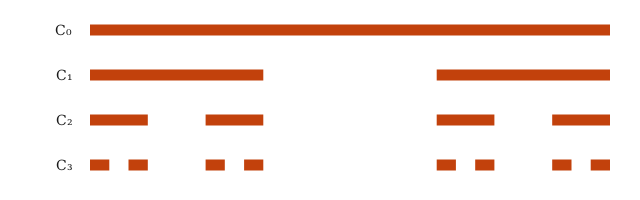
Each \(C_{k}\) is closed, hence \(C\) is closed and measurable. Since at each step \(\tfrac{2}{3}\) of the length is retained, \(m(C_{k}) = (\tfrac{2}{3})^{k}\), and since \(C_{k+1} \subseteq C_{k}\) with \(m(C_{1}) < \infty\), continuity from above gives
\[m(C) = \lim_{k \to \infty} m(C_{k}) = \lim_{k \to \infty}\Big(\tfrac{2}{3}\Big)^{k} = 0.\]Exercise (Characterisation of the Cantor set in base three)
For \(x \in [0,1]\) with expansion \(x = \sum_{i=1}^{\infty} n_{i}/3^{i}\), \(n_{i} \in \{0,1,2\}\) (choosing, when there are two expansions, the one that avoids the terminal digit \(1\)), prove that \(x \in C_{k}\) if and only if \(n_{1}, \dots, n_{k} \in \{0, 2\}\); therefore \(x \in C\) if and only if \(n_{i} \in \{0,2\}\) for every \(i\).
Example (The Cantor function and the uncountability of \(C\))
The Cantor function \(\Phi : C \to [0,1]\), \(\Phi\big(\sum_{i} n_{i}/3^{i}\big) = \sum_{i} \tfrac{n_{i}}{2}\,\tfrac{1}{2^{i}}\) (with \(n_{i} \in \{0,2\}\)), is well defined and surjective onto \([0,1]\). Since \([0,1]\) is uncountable, so is \(C\). Thus \(C\) is a closed, uncountable set of Lebesgue measure zero.
A non-measurable set
Lemma (Steinhaus lemma: \(E - E\) contains an interval)
Let \(E \subseteq \mathbb{R}\) be measurable with \(m(E) > 0\). Then the set \(E - E = \{x - y : x, y \in E\}\) contains an open interval centred at \(0\).
Proof: One may suppose \(m(E) < \infty\) (replacing \(E\) by \(E \cap [-R, R]\) with \(R\) large, of positive measure). With \(\varepsilon = \tfrac{1}{3}\), take an open set \(G \supseteq E\) with \(m(G) < (1 + \varepsilon)m(E)\) and write \(G = \bigcup_{k}[a_{k}, b_{k}]\) with disjoint interiors. Setting \(E_{k} = [a_{k}, b_{k}] \cap E\) we have \(m(E) = \sum_{k} m(E_{k})\) and
\[\sum_{k} m([a_{k}, b_{k}]) = m(G) < (1 + \varepsilon)m(E) = (1 + \varepsilon)\sum_{k} m(E_{k}),\]| hence there exists \(k_{0}\) with \(m(I) \leq (1 + \varepsilon)\, m(\widetilde{E})\), where \(I = [a_{k_{0}}, b_{k_{0}}]\) and \(\widetilde{E} = E_{k_{0}}\); in particular \(m(I) \leq \tfrac{4}{3} m(\widetilde{E})\). We claim that if $$ | d | < \tfrac{1}{2} m(I)\(then\)(\widetilde{E} - d) \cap \widetilde{E} \neq \emptyset\(. Indeed, if we had\)(\widetilde{E} - d) \cap \widetilde{E} = \emptyset\(, then\)m\big(\widetilde{E} \cup (\widetilde{E} - d)\big) = 2 m(\widetilde{E})\(; but\)\widetilde{E}\(and\)\widetilde{E} - d\(are both contained in an interval of length\)m(I) + | d | < \tfrac{3}{2} m(I)\(, so that\)2 m(\widetilde{E}) < \tfrac{3}{2} m(I)\(, that is\)m(\widetilde{E}) < \tfrac{3}{4} m(I)\(, contradicting\)m(I) \leq \tfrac{4}{3}m(\widetilde{E})\(. Therefore, for\) | d | < \tfrac{1}{2}m(I)\(there exist\)x, y \in \widetilde{E}\(with\)x - d = y\(, that is\)d \in \widetilde{E} - \widetilde{E} \subseteq E - E\(. Hence\)\big(-\tfrac{1}{2}m(I), \tfrac{1}{2}m(I)\big) \subseteq E - E$$. |
Note (Translation invariance of the outer measure)
From the definition, \(m_{e}\) is translation invariant: \(m_{e}(E + t) = m_{e}(E)\) for every \(t\), since translating a cover by boxes produces a cover by boxes of the same volume.
Example (The Vitali set is non-measurable)
Define on \(\mathbb{R}\) the equivalence relation \(x \sim y \iff x - y \in \mathbb{Q}\). The class of \(x\) is \(\{x + r : r \in \mathbb{Q}\}\), which is countable; therefore there is an uncountable number of classes. The Vitali set \(E\) is obtained by choosing a representative of each class. Then \(E\) is uncountable and \((E - E) \cap \mathbb{Q} = \{0\}\), since two distinct elements of \(E\) are not equivalent and their difference is irrational. If \(E\) were measurable: the case \(m(E) > 0\) is impossible, because by the Steinhaus lemma \(E - E\) would contain an interval around \(0\) and hence non-zero rationals, contrary to \((E - E) \cap \mathbb{Q} = \{0\}\); hence \(m(E) = 0\). But \(\mathbb{R} = \bigcup_{r \in \mathbb{Q}}(E + r)\), and by translation invariance and subadditivity
\[m_{e}(\mathbb{R}) \leq \sum_{r \in \mathbb{Q}} m_{e}(E + r) = \sum_{r \in \mathbb{Q}} m_{e}(E) = 0,\]which is absurd. Therefore \(E\) is not measurable.
Corollary (Every set of positive outer measure contains a non-measurable set)
Let \(A \subseteq \mathbb{R}\) with \(m_{e}(A) > 0\). Then there exists a non-measurable \(E \subseteq A\).
Proof: With \(E\) the Vitali set, \(\mathbb{R} = \bigsqcup_{r \in \mathbb{Q}}(E + r)\), so that \(A = \bigcup_{r \in \mathbb{Q}} A_{r}\) with \(A_{r} = A \cap (E + r)\). Each \(A_{r} - A_{r} \subseteq (E + r) - (E + r) = E - E\), hence \((A_{r} - A_{r}) \cap \mathbb{Q} = \{0\}\); by the Steinhaus lemma, if \(A_{r}\) were measurable it could not have positive measure, so that \(m(A_{r}) = 0\). If all the \(A_{r}\) were measurable, by subadditivity \(m_{e}(A) \leq \sum_{r} m_{e}(A_{r}) = 0\), contradicting \(m_{e}(A) > 0\). Therefore some \(A_{r} \subseteq A\) is non-measurable.